Electrified Metamaterial Thermochemical Reactors
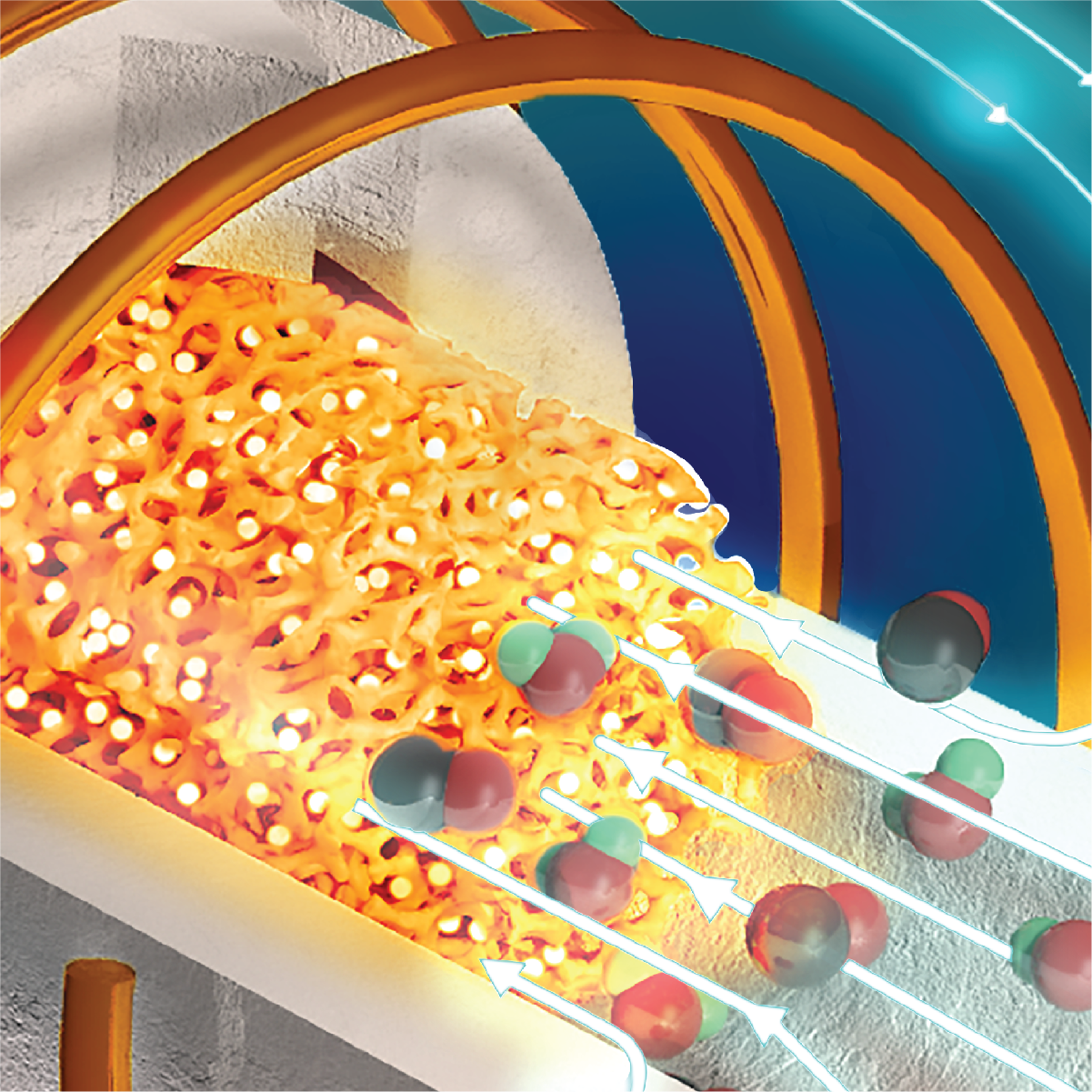
Chemical manufacturing runs on heat, and most of that heat still comes from burning fossil fuels. We are developing new ways to drive thermochemical reactions with electricity, using high-frequency electric and magnetic fields to heat reactors, catalysts and reactants precisely where and when the heat is needed.
Our work sits at the interface of electrical engineering and chemical engineering. We pursue two complementary routes: indirect heating, where fields heat a structure that then transfers heat to a catalyst or reactant, and direct heating, where fields couple straight into the catalysts and reactants themselves.
Ways electricity can heat a reactor
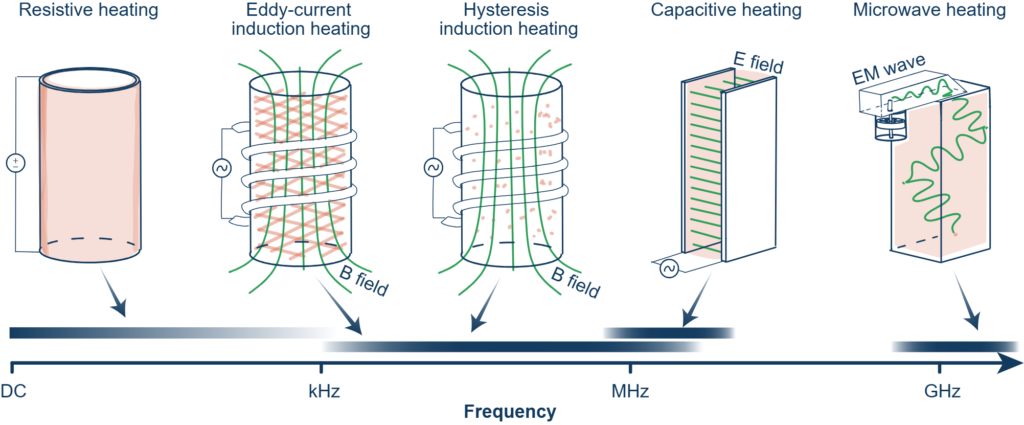
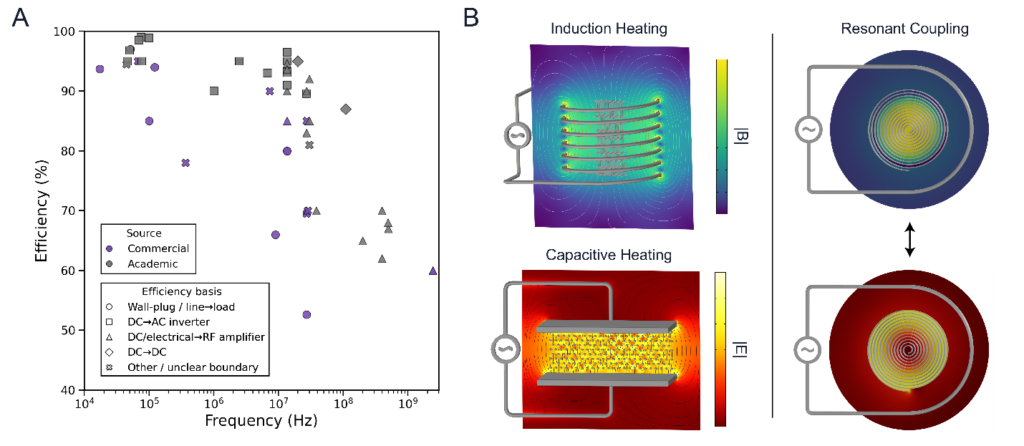
Electricity can deliver heat in several ways, depending on frequency: resistive heating at DC, induction and hysteresis heating in the kilohertz-to-megahertz range, capacitive (dielectric) heating at megahertz frequencies, and microwave heating at gigahertz frequencies. Each couples to materials differently, and choosing the right one opens new reactor designs.
Part 1: Indirect heating with magnetic induction
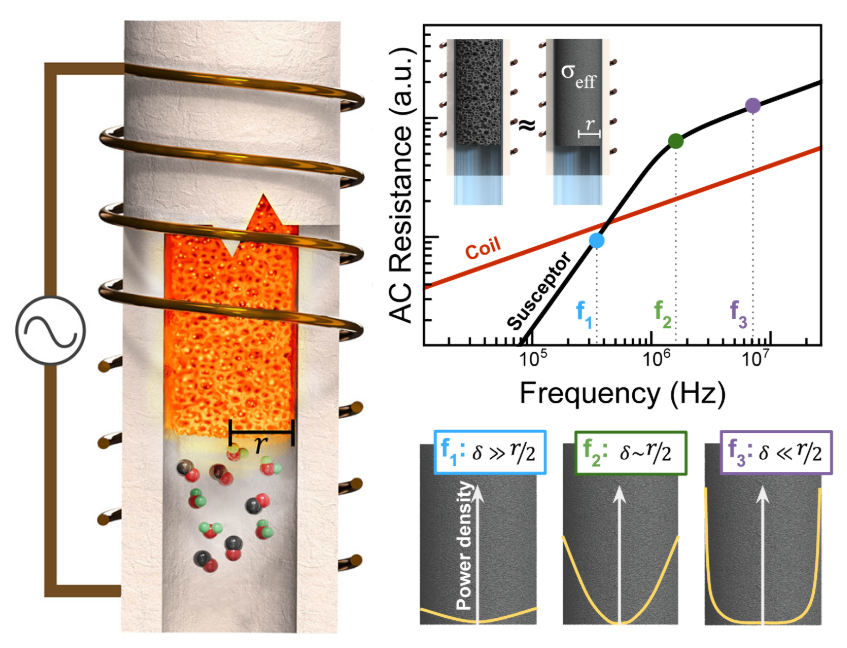
In induction heating, an alternating magnetic field from a copper coil drives currents inside a conductive structure, called a susceptor, which heats up and passes that heat to the reaction.
Volumetric induction heating
Conventional induction heats metal surfaces. We flip the design: when the reactor itself is a low-conductivity susceptor and is driven by high-frequency power electronics, the whole volume heats up and very high heating efficiency becomes possible. We define efficiency here as coupling efficiency, which is the relative amount of power transduced in our susceptor compared to total power input.
The reactor internal as a metamaterial
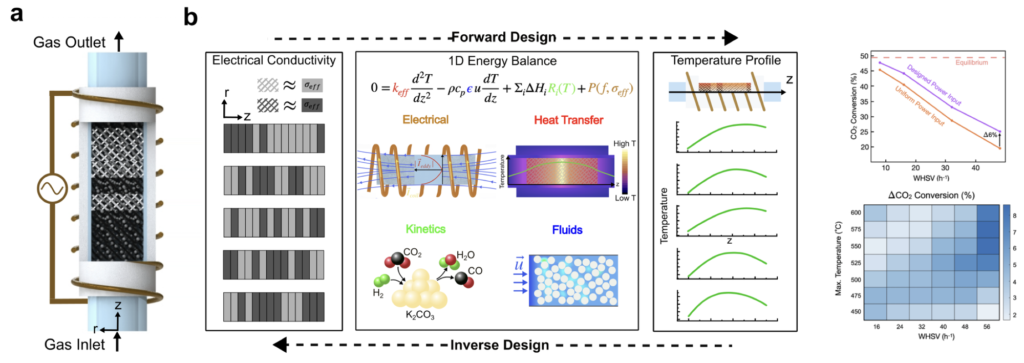
We treat the reactor as an engineered electromagnetic material. Structured conductive ceramic lattices have an effective conductivity set both by what they are made of and by their geometry (their porosity and tortuosity), so we can tune them for ideal induction heating. The same lattices also act as baffles that improve heat transfer, mass transfer and pressure drop.
Codesign Power Electronics with Metamaterial
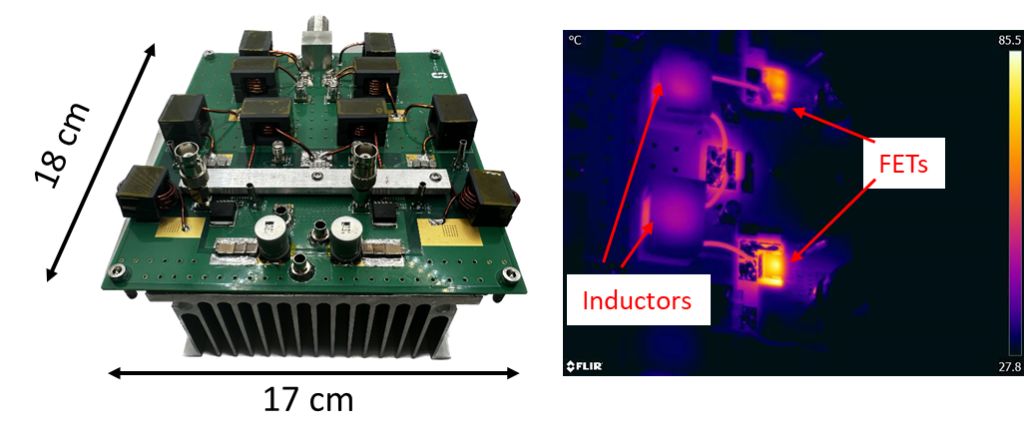
Most research groups exploring electrified thermochemistry use plug and play resistive heaters, microwaves, or inductive heaters. We distinguish ourselves by understanding and building our own power electronics that are specifically tailored to the electrical properties of our reactor to get maximum efficiencies.
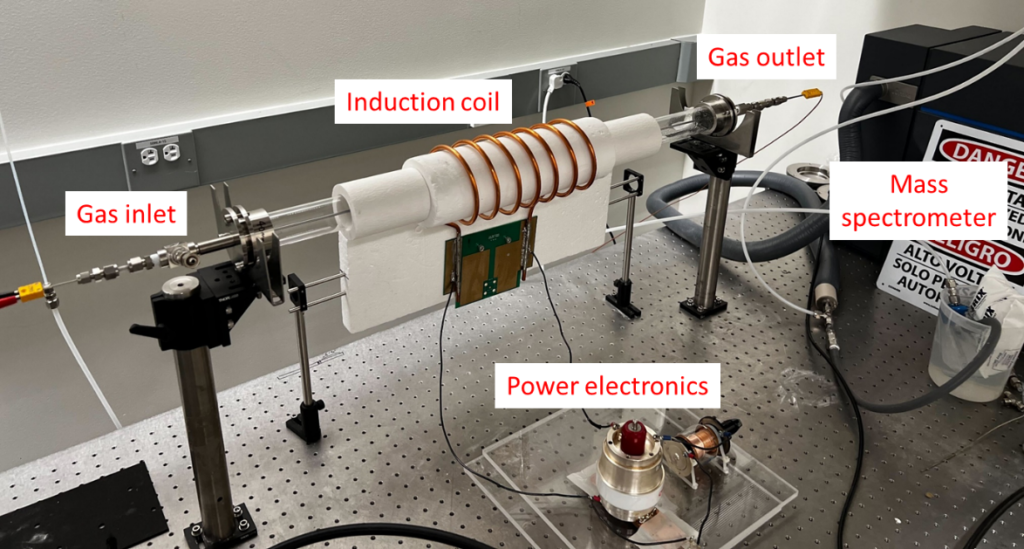
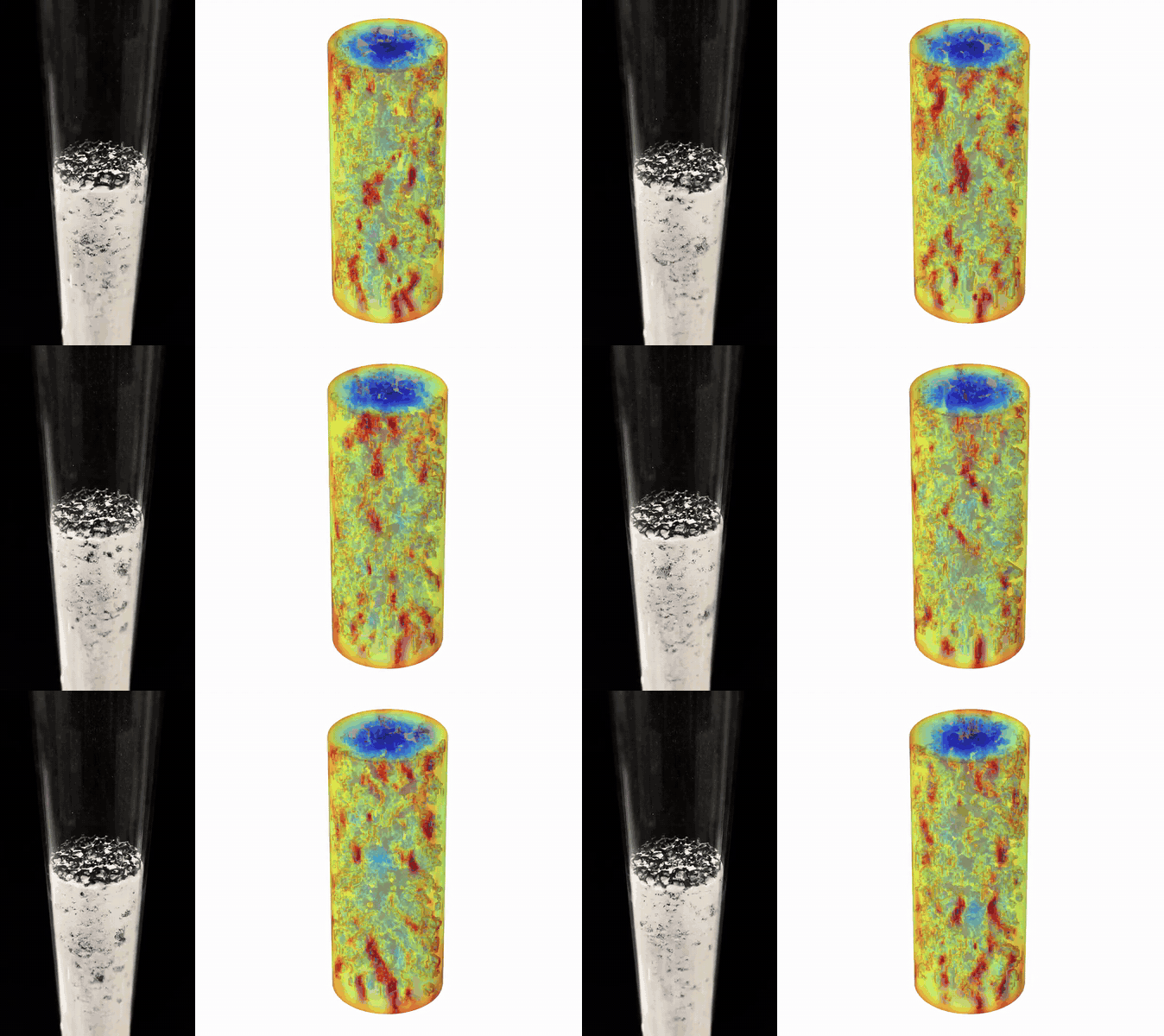
We built our own reactor and power electronics to run the reverse water-gas shift (RWGS) reaction (H₂ + CO₂ → CO + H₂O) on a supported potassium carbonate catalyst. Infrared imaging confirms the heating pattern predicted by our simulations, and 86% of the electrical input is converted to heat inside the reactor.
We have various methods of characterizing the heat, from mid-wave infrared cameras, pulsing power to get thermocouple measurements, and fiber optic temperature sensors. We have made reactors on various scales, up to 6inches in diameter, and have shown that our system level induction reactor energy efficiency gets better as we scale up!

Making reactor heating both decarbonized AND better
We have various projects where we explored indirect heating reactor designs that are better than conventional methods beyond decarbonizing the power input for heating. We believe that using renewably generated electricity is a good start, but in order for their to be a successful green energy transition, these electrified methods need to have more benefits, such as being smaller, more adaptable to fluctuating energy generation, and more.
Inverse Design for Isothermal Temperature Profiles
Uniform heating does not produce uniform temperature. For endothermic reactions such as the RWGS, a nearly isothermal temperature profile gives the highest conversion. By varying the structure or doping of the lattice along the reactor, we can build in a specific non-uniform heating profile. Using reaction-engineering models and inverse design, we start from the temperature profile we want and work backward to the susceptor design that produces it.
Adaptive Supermode for Electricity Intermittency
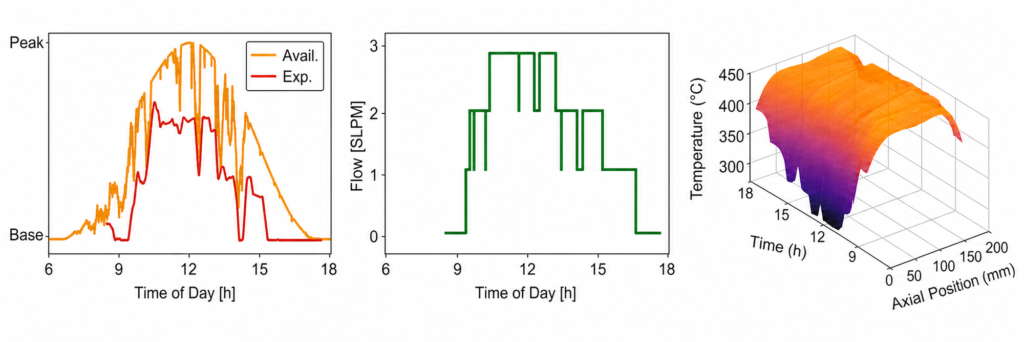
We can also shape heating on the fly. Using a set of coils, switches and capacitor banks, we program magnetic “supermodes” in software to produce a desired heating profile, then use temperature feedback to reach the target temperature profile. Strong coupling between neighboring coils gives fine spatial control, and our models account for it. This means we can adjust to fluctuating renewable electricity generation in a given day while maintaining high conversion efficiencies.
Resonant Reactors
Multiphase Reactions
Part 2: Direct heating with electric fields
Instead of heating a structure, high-frequency fields can couple directly into catalysts and reactants. This can raise thermal efficiency, remove heat-transfer bottlenecks, eliminate heat-transfer fluids and reduce unwanted gas-phase side reactions. We focus on dielectric (radio-frequency) heating at megahertz frequencies, a technology long used for drying and food processing that we believe has broad untapped potential for chemistry.
We are currently finishing off some projects that show this off well, but don’t want to give too many spoilers, so we leave you anticipating more.
From lab to market: Cosine Corp
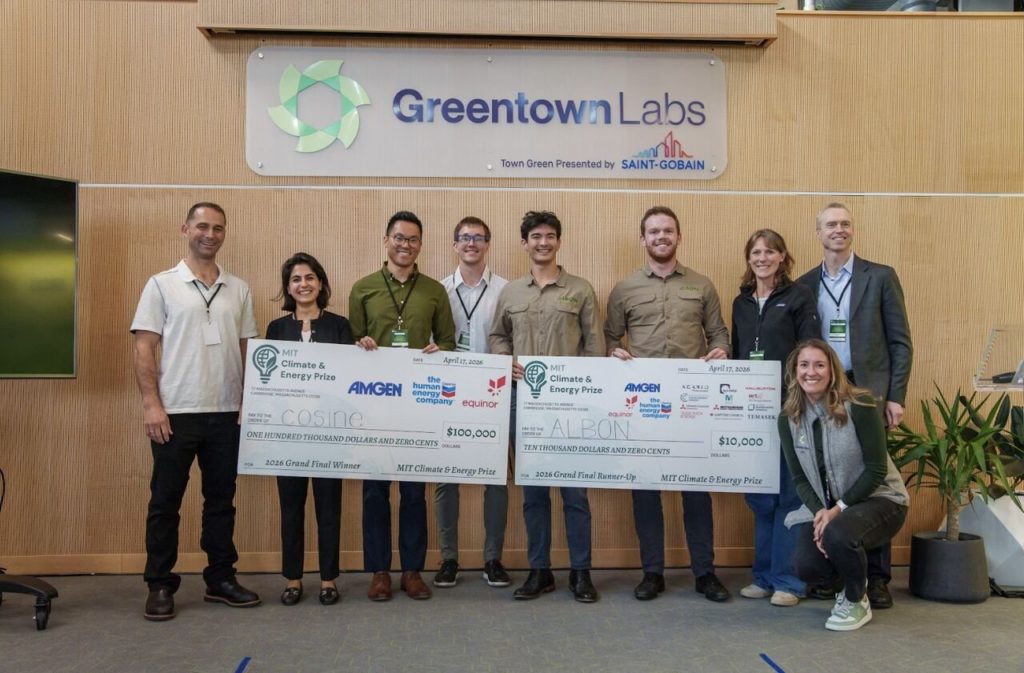
We have launched a startup, Cosine Corp, to commercialize electrified reactor technologies. Cosine won the 2026 MIT Climate and Energy Prize. Learn more at cosine-energy.com.
Where we are headed
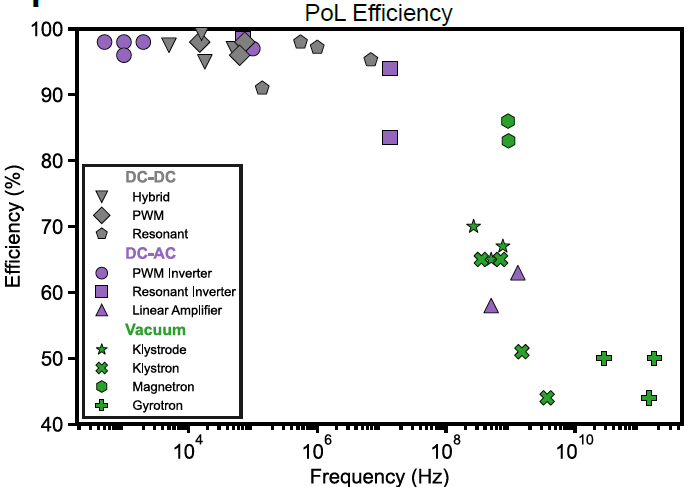
Microwave catalysis has shown the value of heating catalysts directly. Our long-term goal is to deliver those benefits with megahertz fields instead, which can heat more uniformly with fewer skin-depth limits, and which are driven by solid-state power electronics that are far more efficient than microwave sources.
Decarbonize better with us
Electrified reaction engineering draws on many fields at once: electromagnetics, scientific computing, power electronics, controls, manufacturing, classical reaction engineering, unit operations and catalysis. Our group brings these together, and new members join from electrical, mechanical, chemical and materials backgrounds.
We are always looking for new students who are passionate about decarbonization, solid science, and getting their hands dirty with experimental builds.
Selected publications
- Joule, (2024). Our first demonstration with RWGS induction heating
- Nature Reviews Clean Technology, accepted (2026). Our review paper on electrified thermochemistry
- Science Advances 12, eaeg7217 (2026). Ariana’s paper on “lego” pieces for inverse design
- ACS Sustainable Chemistry & Engineering 14, 5922 (2026). Dolly’s paper on CO2 capture inductively heated with a fluidized bed
- Joule, 102704 (2026) Zhennan’s paper on inductively heated molten salt methane pyrolysis
- Our scale up paper
Acknowledgements and contact
We thank our sponsors: Stanford Strategic Energy Alliance, Stanford Doerr School of Sustainability, Stanford High Impact Technology Fund, U.S. Department of Energy, ARPA-E, Shell, National Science Foundation, and TomKat Center for Sustainability.